How can student designers learn to interpret and communicate the significance of a place where natural materials, architectural form, and cultural history intersect? Parsons Paris students recently explored these questions in a semester-long, multi-partner
collaboration involving a family-owned industrial materials company, a micro-architecture nonprofit, and architecture and design students from across Europe.
This past spring, students taking the Collab: Mediating Art & Cultural Heritage class鈥攁 signature course offered annually by the BFA Art, Media, and Technology program鈥攚orked with PRIMA, a micro-architecture park in northern France. Located just a three-hour
train ride from the university鈥檚 campus, PRIMA served as host for more than just a site visit or class field trip. Instead, it was home base for an immersive creative lab in which students tackled a project for a live-industry client.
Led by program director and art historian Stephanie Nadalo, Collab: Mediating Art & Cultural Heritage gives students direct experience working with cultural institutions throughout Europe. Each year, students engage in client-based projects that integrate
research, design, and communication strategies to address real-world needs. Using both analog and digital tools, they are tasked with co-developing solutions to enhance visitor experience, deepen engagement, and translate curatorial content into more
widely accessible formats. Professor Nadalo sees the learning immersions as 鈥渧aluable opportunities for students to extend their learning beyond the classroom.鈥� She explains the benefit of the Collab course and the hand-on work it affords: 鈥淏y engaging
directly with industry partners, students gain practical experience presenting their ideas, receiving and responding to client feedback, and refining their communication and listening skills.鈥�
Students鈥� final projects have ranged from elaborate print guides and interactive maps to children鈥檚 activity kits and social media campaigns. A recent collaboration with L鈥橝iR Arts Association, for instance, gave students the opportunity to apply these
tools in support of an international artist residency, developing mediation strategies that connected contemporary art with historical context and diverse audiences. Nadalo says, 鈥淭hese projects are especially rewarding as students see their designs
realized in real-world contexts鈥攁n experience that not only enhances their portfolios but also reinforces the relevance and impact of the skills they鈥檙e developing.鈥澛�
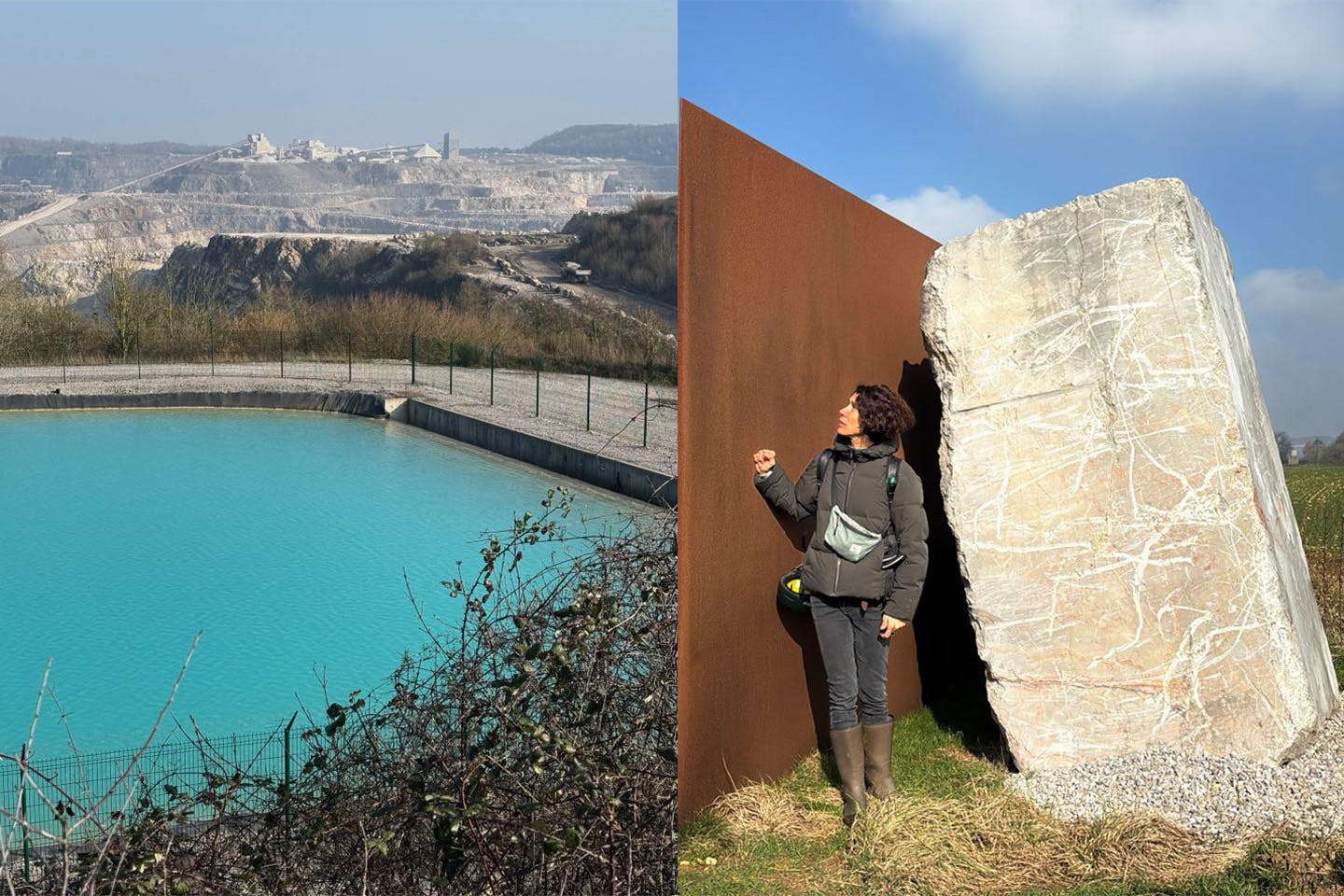 LEFT: View of a quarry site at PRIMA.RIGHT: Francesca Bonesio at PRIMA, standing in front of Harmonie, a sculpture by Marion Conte & Olivier Rold猫s, both ENSAP Bordeaux 2021 laureates.
Founded in 2019, PRIMA is a unique micro-architecture park where designers, artists, and architecture students are invited to turn conceptual sketches into large-scale, inhabitable sculptures. Each structure is built using stone, steel, and concrete sourced
directly from the on-site Groupe CB quarry. The park currently features 19 sculptures, all created in response to annual themes that explore the relationship between architecture and the natural environment.
PRIMA鈥檚 creative director, Francesca Bonesio, is also a faculty member at Parsons Paris. Through her practice at the intersection of pedagogy, construction, and experimentation, Bonesio helps guide the park鈥檚 artistic vision. Since opening to the public
in 2023, PRIMA has begun expanding its programming to include guided tours and community events, some of which will feature mediation tools created by Parsons Paris students as part of this collaboration.
Bonesio explains that PRIMA has for some time worked directly with architecture and design students but this new opportunity for Parsons Paris students to play a key role in interpreting artistic work for a broadened public 鈥渞eflects the shared commitment
of PRIMA and Parsons Paris to hands-on learning and access to art and culture.鈥�
The semester began with in-depth research into land art, spatial storytelling, and micro-architecture, giving students the historical and conceptual grounding needed to take on two real-world project briefs provided by PRIMA.
 Parsons Paris students students explore and document PRIMA鈥檚 sculptural landscape (left to right): shooting content near Vision (2022) by Marine Bouvard and L茅on Felix (ECAL, Geneva, Switzerland; gathering beside Fusion (2022) by
Coline Miossec and Timoth茅 Orloff (HEAR, Mulhouse, France); and walking through Point de Bascule (2020) by Capucine Chess茅 and Elisa Milliancourt (ENSAD Paris).
Parsons Paris students students explore and document PRIMA鈥檚 sculptural landscape (left to right): shooting content near Vision (2022) by Marine Bouvard and L茅on Felix (ECAL, Geneva, Switzerland; gathering beside Fusion (2022) by
Coline Miossec and Timoth茅 Orloff (HEAR, Mulhouse, France); and walking through Point de Bascule (2020) by Capucine Chess茅 and Elisa Milliancourt (ENSAD Paris).
The first brief focused on digital storytelling. Students were asked to create engaging visual content for PRIMA鈥檚 social media platforms, either to introduce the park to new audiences, explain its mission, or highlight the year's design competition on
human and non-human cohabitation. BFA senior Olina Olseth says, 鈥淧RIMA was incredibly open and supportive, which gave us freedom to experiment.鈥澛�
Equipped with cameras, microphones, and sketchbooks, students visited PRIMA for a site tour led by Bonesio and Groupe CB. Their final videos, featuring everything from interviews to stop-motion animations, were shared across PRIMA and Parsons Paris social
channels. The project inspired Olseth to 鈥済o beyond aesthetics and design something both practical and aligned with a client鈥檚 brand identity. The challenge was to balance PRIMA鈥檚 needs with our creative vision, to put forward new ideas while ensuring
they were usable and on-brand.鈥�
 Final deliverables for the course collaboration with PRIMA included a foldable map that combined wayfinding with interpretive content to guide visitors through the park.
The second brief centered on the design of mediation tools for both on-site and online audiences. Students selected from a range of deliverables: redesigning PRIMA鈥檚 adult guide, developing a children鈥檚 activity kit, creating a new park map, or building
an interactive digital map. Professor Nadalo encouraged students to continually test the practical features of students鈥� projects, taking into consideration both the visitor鈥檚 perspective and PRIMA鈥檚 needs. Monica Fraile Morrison鈥攁 graphic designer
and Parsons Paris faculty member鈥攈elped the students refine layouts, typography, and printing solutions to produce professional-level designs.聽
Their initial prototypes were presented to a review panel that included Bonesio, Morrison, and Agathe Tallon, president of the PRIMA foundation. Tallon鈥檚 positive feedback was enthusiastic: 鈥淚 was really impressed by the students' creativity and professionalism!
This kind of collaboration is truly a win-win: it gives students the chance to work on a real case, while offering us fresh perspectives on what we do and how we do it.鈥� 聽BFA Art, Media and Technology senior Lucie Duchene says the experience helped
her come to 鈥渆xpect trial and error in client projects and to push my ideas as far as possible. It definitely opened a door to future projects based on specific environments like this one.鈥�
 Parsons Paris students designed site mediation tools for children, including this box containing聽 natural materials found at PRIMA. Photos by Sarah Thigpen.
When students shared their final deliverables鈥攁 tactile children鈥檚 activity kit, an elegantly designed park map, and a set of architectural memory cards鈥攊t was clear they had created more than just design tools. They had developed ways for new audiences
to understand PRIMA鈥檚 landscape, to imagine how humans might coexist with stone and soil, structure and story. A printed guide became a conversation starter. A digital map became an invitation to explore. And what began as an immersive site visit
became, for many students, their first step into the professional world of experiential design for cultural organizations.
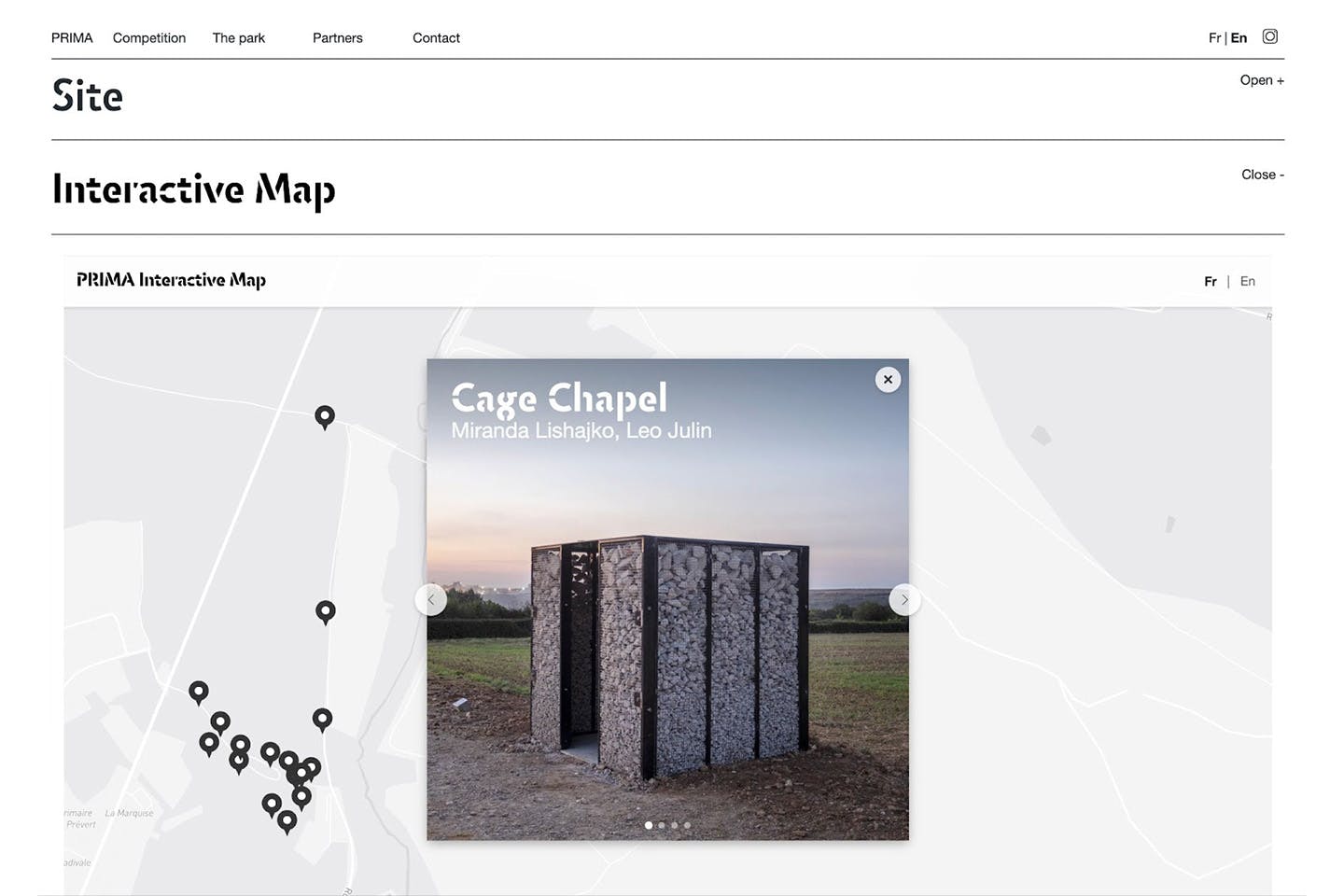 Parsons Paris students Camilla Tacchi, Alice Signorelli, and Susanna Shu developed an interactive map of PRIMA for the nonprofit organization.