Economics, Sociology
This piece was originally featured on .
Across disciplines, academia is reckoning with its own whiteness. In 2017,听听of university faculty members in the United States were white. While racial diversity听听over the past two decades, professors are still much more likely than their students to be white.
The path to tenure is riddled with obstacles. White men听听to become full-time professors, and as a result are more likely to set the agenda and priorities for departments and academic institutions. They receive the highest salaries and positions of power, creating a cycle and social atmosphere that can be difficult to infiltrate.
In collaboration with the American Sociological Association (ASA), two Economics PhD candidates and one Economics PhD alum from The New School for Social Research (NSSR) co-authored three papers on the academic barriers that underrepresented minority (URM) PhD graduates and faculty members face. Published in the听Review of Black Political Economy听鈥� the leading peer-reviewed journal for research on the economic status of African-Americans and the African diaspora throughout the world听鈥斕齮heir听, 鈥淲ho Climbs the Academic Ladder? Race and Gender Stratification in a World of Whiteness,鈥� looks at the career trajectory of Black and Latino economists and sociologists. The other two publications听听in economics and sociology听听the tenure process for faculty members in sociology.
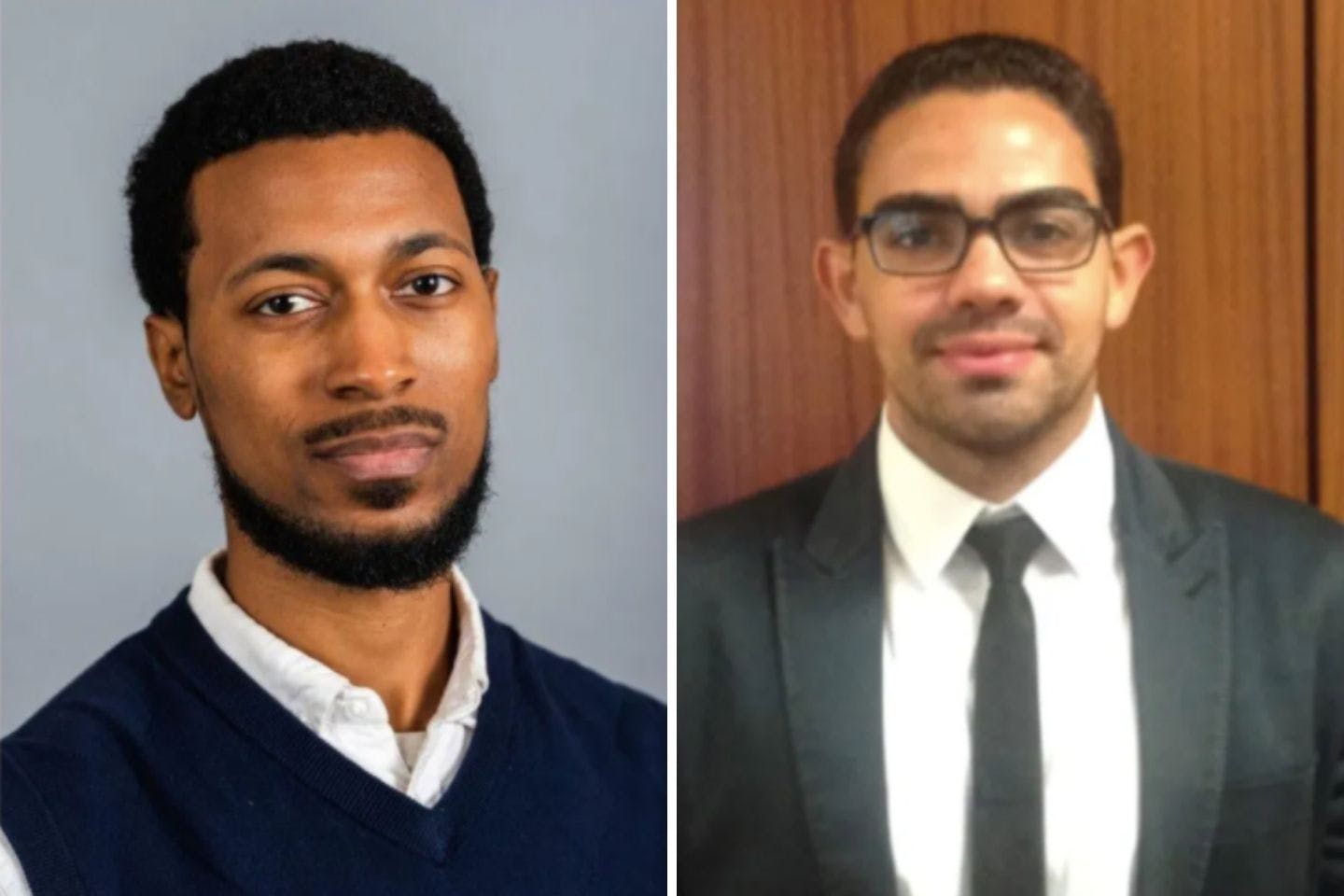
Economics PhD candidates Kyle K. Moore and Ismael Cid-Martinez听(left to right in cover photo)听worked alongside听, Assistant Professor of Economics at Rutgers 好色先生 and an NSSR Economics PhD 2017 alum, to co-author the papers with other scholars of economics and sociology; Roberta Spalter-Roth, PhD, Senior Research Fellow at the Center for Social Science Research, and Amber Kalb, a PhD candidate in sociology at George Mason 好色先生 spearheaded the work demonstrating how the social sciences exclude women of color from intellectual legitimacy. Other co-authors include Jean H. Shin, PhD, and Jason A. Smith, PhD, of the ASA.听 The team presented their findings at the 2019 American Economic Association annual meetings and in 2018 as working papers.
Using a sample population of Black and Latino students in the U.S. who graduated from PhD programs between 1995 and 2006, they set out to uncover what percentage of these URM scholars in sociology or economics succeed in moving up the academic career ladder, identify the existing social structures that can prevent them from doing so, and lay out policy recommendations to remedy the lack of diversity.
Moore and Cid-Martinez spoke with Research Matters over Zoom to discuss the interdisciplinary nature of 鈥淲ho Climbs the Academic Ladder鈥� and what this work means for the future of economics, and academia at large.
Of Economists and Sociologists
Moore and Cid-Martinez are in the last year of their PhD programs, currently working on their dissertations, and both are former research assistants at NSSR鈥檚听. Moore is also a Senior Policy Analyst with the Joint Economic Committee in the U.S. Congress, while Cid-Martinez is a consultant for UNICEF鈥檚 Data and Analytics Unit. They got involved in the project when ASA approached NSSR鈥檚 Department of Economics about comparing faculty diversity within economics and sociology.听听
鈥淭here was a lot of energy behind wanting to compare the two disciplines, to see whether or not things were different for underrepresented minority scholars in economics versus sociology,鈥� Moore says. 鈥淲e were asking the same questions, looking at pipeline problems with diversifying both disciplines and asking which things matter in becoming a tenured professor.鈥�
Cid-Martinez added, 鈥淒espite the fact that they are often treated as disparate fields, both sociology and economics share similar concerns with issues of inequality and inter-group disparities.鈥�
鈥淥ur project invokes W.E.B. Du Bois, who is the shared heritage of economics and sociology, having completed coursework in economics and spearheaded sociological inquiries on stratification,鈥� Toney says.
For 鈥淲ho Climbs the Academic Ladder? Race and Gender Stratification in a World of Whiteness,鈥� the researchers set out to measure stratification by the distribution of academic rank and examine differences based on discipline, institution type, race/ethnicity, gender, and publications in terms of academic career success.听To understand the exclusivity of academia in economics and sociology, the researchers embarked on a labor-intensive, mixed-methodologies approach, reviewing the resumes and CVs of PhD cohorts in the two fields between 1995 and 2006. They reasoned that these graduates should have had enough time to have moved from tenure-track assistant professors to tenured associate professors within eight years, though not all did so, and some should have had time to become full professors within 14 years.
鈥淥ne of the main contributions that we wanted to have with the paper is that we wanted it to be non-intrusive,鈥� Moore says. 鈥淪o we didn鈥檛 want to have to rely exclusively on survey data. We wanted to be able to identify folks and gather as much data in a secondary way as possible to build out the trajectory of their careers.鈥�
This is where the interdisciplinary nature of the project became crucial. 鈥淭hat intensive sort of mixed methods research is not something economists typically do,鈥� Moore says. 鈥淏ut our sociologist colleagues were more familiar with doing that type of work.鈥�
Together, they discovered that the career paths of URM faculty can be limited due to a process that legitimates a non-Hispanic White male set of rules and practices, including value-neutrality听鈥� the idea that a researcher must be totally impartial 鈥斕齛nd objectivity.
One of the major frameworks for the study was the idea of social and human capital and its relationship to advancing an academic career path. There is, of course, the well-known aphorism in academia of 鈥減ublish or perish鈥� 鈥� meaning that how often and in which journals scholars publish work can be a critical metric in the tenure process. Their findings confirmed that publications听are likely the most significant measure leading to promotion. But authoring and getting an article to publication goes much deeper. 鈥淗aving a group of people to relate to and publish work with and co-author with, build relationships with, is key,鈥� Moore says.听
As a discipline, sociology was founded upon the idea of social stratification, or classifying groups of people based on inequalities in power and resources. Applying this approach to economics illuminated how, traditionally, the discipline focuses on the individual rather than looking at larger social structures. The emphasized focus on publication status and other forms of human capital perpetuates a system of exclusivity. By bringing social theory into economics, the researchers were able to identify how critical inclusive social networks can be to progressing a career in academia.
鈥淭hese disciplines don鈥檛 account for the fact that minority faculty do a lot of service work with respect to minority students, and that鈥檚 not often captured in determining who gets tenure, who doesn鈥檛 get tenure, whether or not those support networks exist in those fields,鈥� Moore says. Participation in 鈥榬aced鈥� organizations and activities was similarly devalued, and URM faculty who did not receive tenure likely dropped out of academia and found alternative employment. 鈥淚 think that鈥檚 the case for the social sciences more broadly.听 A lot of these insights from the paper are going to be able to apply more broadly.鈥�
Looking Inward and Ahead at The New School
Broadening the scope of traditional economics and fostering interdisciplinary approaches is at the core of NSSR. 鈥淥ne of the advantages coming from the New School and our department is that we started with a very pluralistic, or heterodox, perspective in looking at economics鈥� Cid-Martinez says. 鈥淪o that in itself provided us with a different lens from which to view and treat these issues.鈥�
听鈥淭he paper itself is a product of The New School,鈥� Moore says. 鈥淢ore people should do more interdisciplinary work and The New School encourages that in its curriculum. I think it鈥檚 a very valuable thing to do just as a scholar.鈥�
While the New School provided the perfect environment to build out this research, no institution is immune from reflecting on faculty diversity. 鈥淲e make important recommendations in the paper,鈥� Cid-Martinez says. 鈥淭hey have a lot to do with not just stopping at diversity hiring. That鈥檚 part of the solution, but it鈥檚 not enough. We share a responsibility to bring in underrepresented minorities to enrich diversity of representation, methods, and thought, but it is even more important to make sure that they have positive opportunities to climb the academic ladder, that they feel included in their universities and departments, and that they are part of the conversation about the direction in which these need to move. These recommendations are pretty universal; they apply to disciplines outside of the social sciences and even to the most progressive universities and departments in the country.鈥�
These papers have gained widespread attention within the greater economics field. With the momentum of national discourse around internalized racism in hiring structures, Moore and Cid-Martinez are hoping to continue the work and move forward these conversations.
鈥淲hat we studied were the things that allowed folks to gain access to tenure in the eight years after their initial cohort in our sample population,鈥� Moore says. 鈥淏ut moving forward, there are new areas of social capital that are important that we haven鈥檛 considered. The main one that鈥檚 big on my mind right now is EconTwitter,鈥� a community of economists active on the social media platform. 鈥淭witter is a relatively new and important vehicle that is driving impact in the profession and academia more generally. I suspect that participation on that platform may be a valuable tool for URM scholars in leveling the playing field. A junior scholar can put their ideas out there and have them be digested in the same format and reach as an established academic.鈥�
These new ways of putting out work and rising within disciplines could be extremely relevant to changing the structure of academia, and deciding who climbs the career ladder towards tenure.
Works Cited
Moore, K. K., Cid-Martinez, I., Toney, J., Smith, J. A., Kalb, A. C., Shin, J. H., & Spalter-Roth, R. M. (2018). Who Climbs the Academic Ladder? Race and Gender Stratification in a World of Whiteness.听The Review of Black Political Economy, 45(3), 216鈥�244.听
Spalter-Roth, R., Shin, J. H., Smith, J. A., Kalb, A. C., Moore, K. K., Cid-Martinez, I., & Toney, J. (2019). 鈥淩aced鈥� Organizations and the Academic Success of Underrepresented Minority Faculty Members in Sociology.听Sociology of Race and Ethnicity,听5(2), 261鈥�277.听
听Spalter-Roth, R., & Kalb, A. C. (2019). Women of Color in Economics and Sociology: Poor Climate, Unequal Treatment, and Lack of Legitimacy. Institute for Women鈥檚 Policy Research.
听